Showing posts with label Digital Literature. Show all posts

Thursday, September 22, 2011

Place and Identity in the Digital Arena (Virtual World and Digital Literature)

"Place is experienced space (Malpas, 1999; Tuan & Mercure, 2004). It is what happens when geographic space takes on meaning of any sort—as an object of memory, desire,or fear. Place can be produced through happenstance (the space of a first kiss), through narrative (the space of childhood that is persistently articulated with story), through familiarity (the space one lives each day),or through representation (the space of art or advertising). This identification with place is an important method of organizing personal experience and social actions." - Using Virtual Worlds to Foster Civic Engagement, Eric Gordon and Gene Koo p206

Place is more than just a name. Place gives identity and meaning to space. Places are marked out and organized according to class, gender, history, power, politics, knowledge, nationality, memory, desire, narrative, and conflict. It is relatively easy to think of a place that has special or specific meaning and then question why it is different from another, perhaps very similar place.

In digital media place takes on a new level of significance in narrative. Place often determines identity in digitally media narratives. Consider the most famous computer games, where location directs action.

World of Warcraft relies on places to order the flow of play. Raids are conducted over boundaries between places. Places take on specific characteristics to enhance play and contextualize characters and action.

It is different in Counter-Strike. Distances, heights and fields of view are that much more meaningful here. Meaningful largely through the functionality of my weapons, to be sure. Still, a variety of tactical behaviours is possible. The spatial structures can be appropriated in different ways. But again, the look of the buildings is largely irrelevant. I learn the valuable properties of places via multiple repeated attempts.

Façade

A "one act interactive drama" where "A couple, Grace and Trip, hosts the player in their apartment for cocktails and proceeds to have a relationship breakdown. Using full typed sentences the player can coach them through their troubles or drive them to be more distant from each other." Facade as a narrative work relies on the representation of place and identity (specifically gender and class) to present a story. In Façade place and gender are combined in the bar and the lounge areas of the three-dimensional apartment that makes up the work. The bar is associated with the male character Trip, and the lounge is given female characteristics though an alignment with Grace. Each character retreats or is drawn into their respective areas in the conflicts of the narrative, often calling for the guest/reader to join them. The objects that are located in the respective areas also function to prompt the reader in responding to the narrative according to associations between gender and place. A painting or a piece of furniture prompts dialogue from the characters to address the reader according to gendered themes in narrative. With the structures provided by the characters and their respective places in the narrative, the reader is restricted to a set number of responses according to gender. In this way the characters and the places they occupy establish the directions for narrative development in Façade.

The relationship between Trip and Grace is composed of stereotypical gender roles and the portrayal of their professional versus private lives. Trip and Grace’s marriage is defined in narrative according to Trip as the stronger and more powerful partner while Grace struggles against being submissive. This, in turn, translates into one character having greater agency where Trip dominates compared to Grace. Many of these conflicts are played out in the narrative in relation to the places depicted in the work. For example, during the evening, he chooses the wine and fixes the drinks. In negotiating the bar and serving the drinks, Grace asks the guest, “Jim, how about something simple, like a nice glass of chardonnay?” only to receive the reply from Trip, “Yeah, no, we need to open this wine! Our friend is here, we're going to enjoy ourselves, that's all there is to it! GRACE: (frustrated sigh)” (Façade). Grace, as representing a narrative direction, is denied agency, in that she is unable to choose her own drink, and once again fails to find her own voice in the dialogue with Trip. As a result the reader is left with the narrative direction initiated by Trip as the only way forward for the story.

The bar area is identified with Trip as part of the gendered structure of the places in Façade. Trip occupies and controls the bar, and he refers to it numerous times with statements that assert a sense of competitive and aggressive pride,

TRIP Oh, yeah, uh, I'm gonna fix us some drinks in a sec! TRIP Ah, you need to help me break in my expensive new set of cocktail making accessories. JIM: cocktails? I love cocktails TRIP: Yeah, hang on, ooh, I'm going to make you one of my fabulous drinks in just a minute, heh! (Façade)

The bar is a masculinized place in Façade by virtue of Trip’s dominance of it, as it is only there that he can display his power and status,

TRIP. Y -- yeah, uh, we need drinks! JIM: large drinks TRIP: This is great... -- (interrupted) TRIP: W -- well, uh, I'm going to open an exquisite Bordeaux! TRIP: Best of the best, you can't buy this in stores. Very, very special - GRACE: God Trip, you are such a wine snob. Just like my dad. (Façade)

The comparison between Trip and Grace’s wealthy father is part of the masculine and authoritative narrative qualities assigned to the bar. Readings are set up according to the power and status implied by the exclusive wine offered by Trip. The alcohol is presented in contrast to the tastes of Grace, who is parodied and humiliated in the contexts of the bar. This humiliation is demonstrated in exchanges such as, “TRIP: Why don't I make us one of my new drink inventions, TRIP: I call it Grace's Inner Soul. TRIP: It's a mixture of chardonnay, bitters and lots of ice” (Façade). Grace is contrasted to the social prestige associated with the bar in relation to Trip.

The bar area functions as support for Trip, which confines the reader to a single male perspective. A picture of the Italian countryside, from a holiday that Trip references as a “second honeymoon” (Façade) is beside the bar, and he draws attention,

TRIP: Oh, Jim, I thought you might like this photo I just put up from our recent trip to Italy. JIM: thanks GRACE: Uhh, it's a beautiful picture of the Italian countryside, of course he'll like it! (Grace sips her Grace's drink.) TRIP: Grace, I know you don't like it, but our friend might. GRACE: By the way, anybody, join me on the couch if you like. (Façade)

If the guest joins Grace on the couch the narrative themes connected to her and prompted by the objects, decorations and art that surround are moved into the centre of dialogue. A move to the lounge by the guest/reader shifts the progression of narrative away from the perspectives of Trip and towards those of Grace. If Trip is not at the bar and instead moves closer to the couch and Grace, the overall narrative moves to center more on the concerns of Grace and eventually on both characters. The two places in the apartment, the lounge and the bar are actually extensions of the characters Grace and Trip as far as narrative is concerned.

From these place-based narrative exchanges identity converges for each of the characters. The reader/guest establishes perspective regarding the characters and the 'best' ways to address them as identities considering the contexts of dialogue.

"There is no self that is prior to the convergence or who maintains 'integrity' prior to its entrance into this conflicted cultural field. There is only the taking up of the tools where they lie, where the very ’taking up’ is enabled by the tool lying there”. - Judith Butler (1990 145)

This is a still image of my avatar in Second Life. It has no biological sex, no genitals or DNA that identifies it according to a scientific standard as male. However, it is consistently referred to by myself and others as 'he' or 'him' and the things it owns as 'his'. Visually, this avatar presents as male and the above image illustrates this 'maleness' in a contemporary style. The business suit, hair style and physical features indicate to me a form of 'soft masculinity', with influence from some of the androgynous gender tropes from popular culture. Lack of facial hair, long eye lashes, large eyes, longish hair style, slight build that lacks developed muscle definition, and thin hips add to the androgyny of the avatar. The image of the avatar is not suffused with sexual imagery and the erotic zones of the body are not emphasized in gender specific ways. The lips are one area of the body that can carry erotic connotation in particular cultures (both male and female) and these are somewhat emphasized with the avatar. The soft masculinity of the avatar can be related to a larger masculine culture in East Asia, where male bodies are represented without excessive muscles or hair and attention is paid to cosmetics and appearance preparation. This video is an example of such a soft masculinity:

South Korean idol boy band, Dong Bang Shin Ki singing Under My Skin in 2008, (Notice the avatar-like flying of some of the characters) Further analysis of this video and "mu-kuk-jok 'soft masculinity'" is HERE
"Feminist geographers often consider the body as a place, a “location or site . . . of the individual”(McDowell,1999). Judith Butler (1990) developed the influential concept of“performativity,”regarding gender identities as a performance in the “stylized repetition ofacts.”To Butler,being a woman is not a natural fact but “a cultural performance [in which] ‘naturalness’ [is] constituted through discursively constrained performative acts that produce the body through and within the categories of sex”(cited in McDowell, 1999,p.54)." Bardzell and Odom The Slave's Body as a Place p252

Apart from the visual appearance of the avatar in regards to gender and sexuality there is also the concept of performing gender. My avatar performs as a predominantly heterosexual identity in Second Life. While stereotyping plays a large role in the performance of heterosexuality masculinity, the attributes of my own avatar that indicates a predominately hetero-orientation can be the same that indicate androgyny; lack of overt sexualized physical attributes, a gender-neutral physical stance and movements, and the absence of queer, bi or gay (HTB) symbols in reference to what is considered the so-called 'default sexuality' (i.e. heteronormativity).

I presented my avatar to some students recently as "fairly standard in regards to gender" and it was only while thinking about it further today that I understood what this can mean. The opening quote, "There is only the taking up of the tools where they lie, where the very ’taking up’ is enabled by the tool lying there” from Judith Butler is very much about the components of gender performance. When we work in virtual worlds we operate under the same rules to which Butler refers. What is available is what people can use to identify socially with gender and sexuality. Agency emerges from this range of possibilities according to what is tolerated, permitted and encouraged in the "conflicted cultural field"..

The avatar above references symbols of soft-masculine power in the suit, formal qualities (expensive clothes, neck tie) and attention to appearance. These factors ally power with economic wealth in the formation of identity. These qualities are surprisingly similar to many of the images from the video of the South Korean pop band. The role of my avatar in my job influences the references and values I represent within it. I have attempted to build connections between agency and power in my avatar by referencing formal qualities in male contexts. The technological aspects of my job can be related to the East Asian cultural reference where a stereotype of a technical mediated identity is common. I also think about Science Fiction novels, especially those by William Gibson, and the ways they portray East Asia as a digital society where gender-ambiguous figures move freely in information spaces.

Background Commentary

In performing the above reading I considered the following:

- Performativity: We have talked about gender being created performatively by our everyday practices. In this sense the practice of creating avatars is part of the process of creating gender. So how do the avatars (re)produce gender stereotypes? How do they exceed them?

- Representations of gender and sexuality: as both representing what is not present (the avatar representing 'me' in SL, the avatar's gender representing cultural notions/norms of gender such as the heteronormative), and as actually creating/being what is thus represented (and never just 'mirroring' the student, or cultural notions/norms). So, what do the avatars create when it comes to gender/sexuality? What do they think of the potential political power behind this kinds of representations? Do you think about the looks of the avatar's as being feminist in any sense? If so - how?

- The Butler quote: "There is only the taking up of the tools where they lie, where the very ’taking up’ is enabled by the tool lying there”. This is somewhat difficult to grasp, but virtual worlds are good examples in order to illustrate it, since "the tools" (for performed gender for example) are on the one hand per-determined by the architecture of the computer program, and on the other hand, as is the case with Second Life the tools for the manipulation of gender imagery and performance are many.

- Agency: The above also relates to agency, and having a choice (although always conditioned by the "convergence or who maintains 'integrity' prior to its entrance into this conflicted cultural field").

- Gender is said to be the prime thing in people's identifications and in identifications of others. So what choices are made in relation to identify and identification in the construction of the avatar? Initially it is necessary to decide whether the avatar is male or female (which is of course an interesting thing in itself). Why does one choose the avatar's gender as the same as my own? Why does one choose an oppositional gender? In relation to becoming a subject occurring in relation to subjecting oneself to different norms (for example gender norms). In a virtual environment simulations of gender performance can be experimented with. My avatar is not specifically incomprehensible and this is a result of reference to standard contemporary gender norms .

For further references to avatars, agency and the representation and performance of Self see HERE.

"Donna Leishman’s “Red Ridinghood” is an interactive story and a prime example of electronic literature. The viewer has to click on certain objects within the scene in order to make the story progress resulting in interaction. While at one point the viewer is offered two choices to click, both routes end up leading to the same ending. This type of story can be mistakenly labeled as a ‘game’ meaning that the viewer actually has the ability to change the outcome of the story line. Yet “Red Ridinghood” does not actually offer the reader to choose the ending of the story, it simply allows them to become an essential part of the story. Thus the literary aspect is kept in tact, the viewer is allowed a sense of control over the story, but is ultimately not able to change the plot in any way. This element of interactivity with the story is makes “Red Riding Hood” an example of how an interactive story can still be literature and not art or even an online game. The narrative cannot be completed without an outside force, in this case the reader clicking through the passages. The narrative itself is also something that can only be produced on an electronic level. It is made up of pictures and sounds rather then words. While Little Red Riding Hood is a common story, the illustrations put a new twist on it, making it a new urbanized fairy tale that doesn’t adhere exactly to the original plot line."

Place plays a significant role in the establishment of Red as a characte both in terms of the depicted body and the locations it occupies:

"Red and Wolf are two deeply intertwined characters acting out in this story. Red's perspective is one of compromised authenticity; so much of the background storyline is acted out through her dreams (or written in her diary) that it is hard to know how her evident inner turmoil has skewed the Wolf's character. Leishman excels in bringing to life the complex inner workings of a young woman, particularly through the view of Red's bedroom. Who is Red? What are her mental fabrications and what is fact? These are questions that the author begs us to raise with this scene." - A Peak into the Bedroom

Tuesday, February 2, 2010

Social Media as Text

In Close Reading New Media, Jan van Looy and Jan Baetens write

The decentered nature of electronic text empowers and invites the reader to take part in the literary process. Poststructuralist theorists predicted a total liberation of textual restrictions imposed by the medium of print. However, while these are culturally significant claims, little attention has been paid to their realization


In the seven years since these words were published little has changed in regards to claims made in regards to "a total liberation of textual restrictions imposed by the medium of print". The so-called social media which is filling the lives of so many people today is based upon an often unstated premise that 'You' are the media. That the limitations of what can be created and published are based on the limits of the imagination and ingenuity of those who sign up for Blogger, Flickr, Facebook, Twitter, Myspace and so on. But if we pause time and stop to consider the mechanics, what could be termed the archiTEXTure, of social media platforms, what do they reveal when they are exposed to close readings as texts?

A close reading is a product of a particular approach to literature that has developed during the past two hundred years, although it has its origins in the humanism on the Renaissance.

"In literary criticism, close reading describes the careful, sustained interpretation of a brief passage of text. Such a reading places great emphasis on the particular over the general, paying close attention to individual words, syntax, and the order in which sentences and ideas unfold as they are read" Wikipedia


Close reading of digital media pays attention to the components of the text and how they relate to each other. It analyzes and attempts to explain how possible meanings are built up according to the choices available in the digital text and what the texts present for reading. When you perform a close reading of a digital text look at the relationships that are present in the text, what values and hierarchies are represented, and the possible choices the texts makes available in responding to it.

The Text
I would like to begin by clarifying what is a text. Looy and Baetens return to the great poststucturalist theorists for gaining perspective of what is a text in the context of the digital,

"The passive reader becomes an active participant choosing his own path and assembling not just his own interpretation of the text (level of the signified), but also his own text (level of the signifier). Texts no longer have a beginning or an ending being a web of interlinked nodes or rhizome (Deleuze & Guattari through Landow 1997: 38)."


Going further along this road, "A text is a coherent set of symbols that transmits some kind of informative message" (Wikipedia).

Things to Read For
1.Authorship
Included in the concept of the digital text as social media is an enormous range of variables. They can be grounded in the fact that there is no single author in social media. Even a blog is a product of collaboration, from the design (consider if one downloads a template) to the comments section on each post. Some best blogs on the web are group projects, such as the HUMlab Blog, WFMU Beware of the Blog, and Grand Text Auto. The principle of many-to-many in social media has great implications for authorship. How textual components are transmitted and presented is in terms of "such modes as appropriation, synthesis, recombination, mutation and generation, postmodern poetics expresses a commitment to the dialogical, social world"(Joseph M. Conte, Unending Design: the Form of Postmodern Poetry).Similarly, in the Web-based communications, everyone is a potential author, contributor, and message creator . The concept of a traditional author (or a message creator) is deconstructed and replaced by a collective authorship. The individual as well as an organization cedes control over the communicative process. Attention should be paid to the material configuration of the media, as it is where form is adhered to. In his book, Code and Other Laws of Cyberspace, Lawrence Lessig argues that code displaces the balance in copyright law and doctrines such as fair use (135). If it becomes possible to license every aspect of use (by means of trusted systems created by code), then no aspect of use would have the protection of fair use (136). The importance of this side of the story is generally underestimated and, as the examples will show, very often, code is even (only) considered as an extra tool to fight against "unlimited copying".


2.Space

Digital texts are generally spatial. By this I mean they use the elements of space that are part of the media to transmit informative messages. Let take a look at Grand Text Auto


In considering space one should look for contrasts, colors, space between features, the size and possible areas of dominance, how the eye is drawn across the screen, how links are arranged, how time is represented in the page, and functional aspects such as ease of differentiation between permanent and temporal features.

Prezi is a good example of how time is presented in space:


How Prezi forces us to subscribe to its depiction of time is a result of the rules of its code. A hierarchy is created by the two dimensional arrangements of elements in Prezi presentations.

3.Repetition
The repetition of elements in a digital text which suggests responses that can be made to it. Janet H Murray writes it is devices for patterning language into units that make it easier for bards to memorize and recall" that "we in a literate era devalue as repetition, redundancy and cliché," but that make it possible for each performance to be improvised on the spot, so that they are essentially multiform, with "no single canonical version." Repetition of words, images, audio assists in guiding reading of digital texts.

A Reading of Facebook
Facebook is a horizontally arranged network based on association rather than interest (unlike Myspace). One builds connections with others in the viral sense; email is used to bring contacts into the system. By allowing Facebook access to email account (Hotmail, Gmail, Yahoo and AOL) mass mail-outs can be one way of building up you friends list and of course bringing contributing to the Facebook database. The other way of finding contacts is through work, school and college. I myself went to a tiny high school in a small town in rural Australia (Oakey State High…go the Bears!) so it is not on the list of schools (you can only choose, not type in). But the town I went to university in is well represented. Interestingly the private schools (as in non-government) seem to be much more represented in the lists of high schools. In Brisbane, the capital of my home state there are 13 High schools listed and only 3 of them are government schools that did not charge fees. I wonder if this reflects the overall demographic of Facebook or the use of digital social software in Queensland, Australia. There is also college and company searches but when you type in the title Facebook will not prompt the line for you as there are no prior entries in the database of the term.

Setting up a profile on Facebook is not too different from other social platforms. There is lots of plug-ins that can be loaded into a page; video, books I’ve read, photos, movies and the list is growing daily. There are issues of readability relevant in regards to a Facebook site. I myself believe minimalism works on the web, this is a design question but I try to keep my site fairly sharp and to the point. I decline lots of offers from friends for zombie clubs, vampire attacks and poking or biting my colleagues. I have decided it is an identity thing I have going on Facebook and not a game. I am also fully aware of what I disclose on Facebook as it is a public space, even if it does have something of a gated community feel to it. I don’t think the gated (restricted access, password protected etc.) is that substantial.

Once you have a profile on Facebook then you can join interest groups. These can be from the sublime to the ridiculous: “I bet I can find 1,000,000 people who dislike George Bush!” was a group I just noticed. I have just applied to be friends with digital researcher Anna Valdes (I have met her, I wonder if she remembers me?) in order to join her group Gender and Computer Games. The gender group is made up of serious academic researchers, game developers and players in Sweden. A worthwhile project I believe. The groups are what led me into the close reader of Facebook, as we need to create a group for our honored guests visiting Umeå for the annual awards ceremony. There are actually 3 stages we have to get through to create a group:

1. Joining Facebook
2. Becoming a friend with one central person who is organizing the group if it is not open.
3. Joining the group
Each of these stages has to be fulfilled if one is to be a member of the group. If it is a closed group only the administrator of the group can invite another;


You can join any open group on your networks. Also, you can join any “global” group that is open. These groups can be found using the Search page. Just type in a keyword for the group you want to find and specify that you are looking for “Groups.” Alternatively, you can browse by category from the Groups page. When you find the group you are looking for, click on the “join group” link on the right side of the screen. Some groups require administrative approval for you to join. If you try to join these groups, you will have to wait for an admin to let you in. Finally, there are some groups on Facebook that are invitation only. You cannot request to join these. Only an invitation from a group admin will give you access

So sometimes you have to make each member a friend before you can invite them to the group (tedious). If you send an invite to become a friend to someone who is not a member of Facebook they are asked in the same mail to join Facebook and become members of the group once they accept the invitation that appears in the Facebook Inbox.

All these considerations add up to becoming the texture of Facebook. The texture is the layers of text that have to be negotiated to engage with the site. Texture combines the collaborative aspects of Facebook (millions of authors creating content) with the structures and laws that come from those that created the Facebook platform. In essence with the efforts to create the annual awards group, I have been navigating the texture of Facebook in something akin to what Jerome McGann described in Radiant Textuality: Literature After the World Wide Web (2001) as a ‘Deformance’, the moving from non-normative readings of Facebook (I have no idea what I am doing and I make ‘mistakes’) to normative readings, where the texture becomes familiar and I create the group site that is suitable for the annual awards ceremony.

Excercises


I would like you to perform a close reading of a social media text. What you are actually paying attention to in critiquing the possible meanings of these texts is interaction design.

"Interaction design (IxD) is the study of devices with which a user can interact, in particular computer users. The practice typically centers around "embedding information technology into the ambient social complexities of the physical world."[1] It can also apply to other types of non-electronic products and services, and even organizations. Interaction design defines the behavior (the "interaction") of an artifact or system in response to its users. Malcolm McCullough has written, "As a consequence of pervasive computing, interaction design is poised to become one of the main liberal arts of the twenty-first century" Wikipedia

You can find some subject texts here:

Blogs
Wiki
Networks

As well as the usual social media sites you have been working with (i.e. Facebook, Twitter, MySpace etc.)

Monday, November 23, 2009

An Introduction to Digital Literature

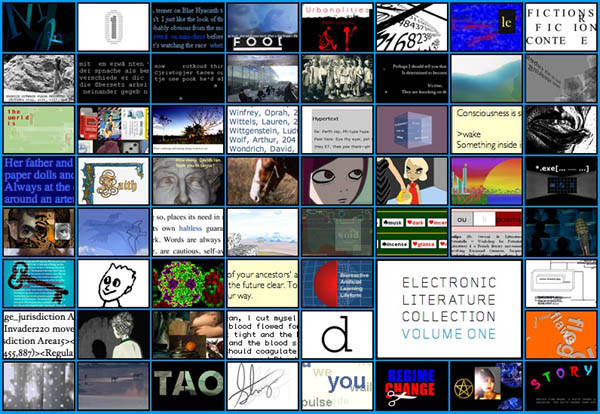
elocollection.jpg

What is Digital Literature?

The term refers to works with important literary aspects that take advantage of the capabilities and contexts provided by the stand-alone or networked computer. Within the broad category of digital literature are several forms and threads of practice, some of which are:

  • Hypertext fiction and poetry, on and off the Web
  • Kinetic poetry presented in Flash and using other platforms
  • Computer art installations which ask viewers to read them or otherwise have literary aspects
  • Conversational characters, also known as chatterbots
  • Interactive fiction
  • Novels that take the form of emails, SMS messages, or blogs
  • Poems and stories that are generated by computers, either interactively or based on parameters given at the beginning
  • Collaborative writing projects that allow readers to contribute to the text of a work
  • Literary performances online that develop new ways of writing

The ELO showcase, to which new works are continually added, provides a few outstanding examples of what they term electronic literature. I believe the proximity of the digital in electronic literature warrants the use of both terms. According to the Wikipedia electronic literature is a literary genre consisting of works of literature that originate within digital environments.

To begin with, it is necessary to define what we mean by ‘digital literature’. We can distinguish at least three quite different meanings for this expression:
1. Digital Publishing. This perspective focuses on the production and marketing of literature and books, with the aid of digital technology. It includes such phenomena as eBooks, Print On Demand, AudioBooks as MP3 files etc. Content-wise it is a question of literature in a traditional sense.
2. Scholarly literary hypertext editions for educational and research purposes. This category includes hypertextually annotated literary works, as well as multimedia implementations of classics. Mainly, because of rights issues, these are older works, free of royalties.
3. Writing for Digital Media. Digital texts are always programmed text, on one level they are computer code. This opens up a limitless field of literary play and experimentation, as texts can be programmed to behave in a more or less dynamic way. We call this perspective cybertextuality and the works cybertexts, following Espen Aarseth (1997). Cybertextuality is an umbrella term for different types of digital texts, such as hypertexts, kinetic texts, generated texts, texts employing agent technologies etc.
All three categories are important for literary studies, and they also bear implications for literary pedagogy.
Raine Koskimaa, Teaching Digital Literature: Code and Culture


Medieval Help Desk
The Scriptorium was in turmoil. Brother Paul, the precentor in charge, had detected a murmur from the back row and, furious that the rule of silence was being compromised, strode down the aisle just in time to see Brother Jacob tuck something under his robe. When he demanded to see it, Brother Jacob shamefacedly produced a codex, but not one that the antiquarii of this monastery had copied — or of any monastery, for this Psalter was printed. Shocked as much by the sight of the mechanical type as Brother Jacob's transgression, Brother Paul so far forgot himself that he too broke the silence, thundering that if books could be produced by fast, cheap and mechanical means, their value as precious artifacts would be compromised. Moreover, if any Thomas, Richard or Harold could find his way into print, would not writing itself be compromised and become commonplace scribbling? And how would the spread of cheap printed materials affect the culture of the Word, bringing scribbling into every hut and hovel whose occupants had hitherto relied on priests to interpret writing for them? The questions hung in the air; none dared imagine what answers the passing of time would bring.

Electronic literature, generally considered to exclude print literature that has been digitized, is by contrast "digital born," a first-generation digital object created on a computer and (usually) meant to be read on a computer. The Electronic Literature Organization, whose mission is to "promote the writing, publishing, and reading of literature in electronic media," convened a committee headed by Noah Wardrip-Fruin, himself a creator and critic of electronic literature, to come up with a definition appropriate to this new field. The committee's choice was framed to include both work performed in digital media and work created on a computer but published in print (as, for example, was Brian Kim Stefans's computer-generated poem "Stops and Rebels"). The committee's formulation: "work with an important literary aspect that takes advantage of the capabilities and contexts provided by the stand-alone or networked computer."
Hayles, N. Katherine, ”Electronic Literature: What is it?”

Navigation is not just how readers move through electronic literature but how they read digital works. When and how the reader inputs a command, whether it is a mouse-click or a typewritten word, this action affects the work’s performance and the reader’s engagement with it. In other words, navigation enables the digital work’s performance and its signification. To understand how navigation is signification in electronic literature, let’s examine a few modes of navigating electronic literature and the their distinct effects on the reading practices and signification processes they produce.
Pressman, Jessica. ”Navigating Electronic Literature."

Konkret poesi
At the intersection between games, puzzles, poetry and prose is concrete poetry:
Concrete poetry, pattern poetry or shape poetry is poetry in which the typographical arrangement of words is as important in conveying the intended effect as the conventional elements of the poem, such as meaning of words, rhythm, rhyme and so on. It is sometimes referred to as visual poetry; a term that has evolved to have distinct meaning of its own, because the words themselves form a picture. This can be called imagery because you use your senses to figure out what the words mean. Concrete poetry has a long history. Poems that Go is an online periodical that publishes kinetic digital concrete poetry.


Worth Considering in the Reading of Digital Literature
Space
A defining characteristic of digital literary works is how space is utilized within them to aid in the conveyance of meaning. I believe space is the raw material of design and within its frame it is the grounding of the places that feature in the work. Space is used in a number of ways in works of digital literature;
* As a means to convey rhythm and a sense of timing,
* To regulate and direct the choices that can be made in navigating to the work,
* To create pauses and gaps in the work for reader reflection
* To arrange the features of the work in the sense of design, including the creation or representation of place,

Reading Paths
The reading paths of a digital literary work can take various forms, the tree and the labyrinth are the most common.

Layers
The ways the sections or segments of a digital literary work combine can be thought of in terms of layering in order to understand how they function within the structures of narrative media. Layering is present in the combinations of audio, image and text when moving through a three dimensional space that tells a story.


Dreamaphage by Jason Nelson (2004) shows how layering in a work of digital literature is used to organize the reading experience. Order is established in space by the layering of the components.

Speed
The feedback system of a digital literary work is important for how the story can be realized. How information is entered into the digital work of literature and what results it returns drives much of the narrative structure of the work. Katherine Hayles has written:

"Complex feedback loops connect humans and machines, old technologies and new, language and code, analog processes and digital fragmentations. Although these feedback lops evolve over time and thus have a historical trajectory that arcs from one point to another, it is important not to make the mistake of privileging any one point as the primary locus of attention, which can easily result in flattening complex interactions back into linear casual chains." My Mother Was a Computer


When we read digital literature it is not only words we read. The images, spaces, sounds and representations of media (radio, film, newspapers, TV, architectures) in a digital work are interepreted and responded to by us. How fast each of these systems returns a result to us establishes much of how the digital work is read. The speed of the publishing system, the resolution of images, the size of audio files in a work provide a unifying thread in the work that does not privilege one site in the system. Rather how the speed of the work directs reading ties the diverse media forms together.

Sources for Digital Literature
Jim's Archive
A growing collection of online works

Facade
An "interactive one-act drama" that is installed on each of the computers in HUMlab. Please experiment with it.

Alleph
A complex work that involves seven visual spaces with three links in each. Telling a story of migration and self identity.

Dreamaphage
A dystopian narrative about a plague and those who are infected and those who are left behind.

Last Meal Requested
An artistic recounting of the cruelty of people and the struggles of minorities and the disempowered. By Japanese/Swedish artist Sachiko Hayashi

Fast City
A multimedia representation of Singapore in poetic form. By Don Bosco. You need to download and install it.

Sunday, April 12, 2009

Digital Literature, Bakhtin and the Dialogic Principle


From Dim O'Gauble

What is Digital Literature?
See http://eliterature.org/pad/elp.html
The term refers to simulative and representational works with important literary aspects that take advantage of the capabilities and contexts provided by the stand-alone or networked computer. Within the broad category of digital literature are several forms and threads of practice, some of which are:

•Hypertext fiction and poetry, on and off the Web
•Kinetic poetry presented in Flash and using other platforms
•Computer art installations which ask viewers to read them or otherwise have literary aspects
•Conversational characters, also known as chatterbots
•Interactive fiction
•Novels that take the form of emails, SMS messages, or blogs
•Poems and stories that are generated by computers, either interactively or based on parameters given at the beginning
•Collaborative writing projects that allow readers to contribute to the text of a work
•Literary performances online that develop new ways of writing
(Adapted from the Electronic Literature Organization)

Henry Jenkins, Game Design as Narrative Architecture
Jenkins' essay outlines a way of thinking about computer games, as digital communicative artifacts, some of which embody stories or narratives.
Central to Jenkins ideas about computer games and narrative are:

1. Spatiality
“Before we can talk about game narratives, then, we need to talk about game spaces. Across a series of essays, I have made the case that game consoles should be regarded as machines for generating compelling spaces, that their virtual playspaces have helped to compensate for the declining place of the traditional backyard in contemporary boy culture, and that the core narratives behind many games center around the struggle to explore, map, and master contested spaces.” (Jenkins 4)

2. Environmental Story Telling
“Environmental storytelling creates the preconditions for an immersive narrative experience in at least one of four ways: spatial stories can evoke pre-existing narrative associations; they can provide a staging ground where narrative events are enacted; they may embed narrative information within their mise-en-scene; or they provide resources for emergent narratives.” (Jenkins 5-6)

3. Enacting Stories
“Spatial stories are held together by broadly defined goals and conflicts and pushed forward by the character's movement across the map. Their resolution often hinges on the player's reaching their final destination, though, as Mary Fuller notes, not all travel narratives end successfully or resolve the narrative enigmas which set them into motion. Once again, we are back to principles of "environmental storytelling." The organization of the plot becomes a matter of designing the geography of imaginary worlds, so that obstacles thwart and affordances facilitate the protagonist's forward movement towards resolution. Over the past several decades, game designers have become more and more adept at setting and varying the rhythm of game play through features of the game space.” (Jenkins 7)

4, Embedded Narratives
“According to this model, narrative comprehension is an active process by which viewers assemble and make hypothesis about likely narrative developments on the basis of information drawn from textual cues and clues. As they move through the film, spectators test and reformulate their mental maps of the narrative action and the story space. In games, players are forced to act upon those mental maps, to literally test them against the game world itself. If you are wrong about whether the bad guys lurk behind the next door, you will find out soon enough - perhaps by being blown away and having to start the game over.” (Jenkins 9)

5. Emergent Narratives
"The characters [of The Sims] have a will of their own, not always submitting easily to the player's control, as when a depressed protagonist refuses to seek employment, preferring to spend hour upon hour soaking in their bath or moping on the front porch. Characters are given desires, urges, and needs, which can come into conflict with each other, and thus produce dramatically compelling encounters. Characters respond emotionally to events in their environment, as when characters mourn the loss of a loved one. Our choices have consequences, as when we spend all of our money and have nothing left to buy them food. The gibberish language and flashing symbols allow us to map our own meanings onto the conversations, yet the tone of voice and body language can powerfully express specific emotional states, which encourage us to understand those interactions within familiar plot situations." (Jenkins 12)

Jenkins in Narrative Architecture provides a basic structure for thinking about digital media in terms of texts; as systems of meanings that can be located in cultures. Once a work of digital media is classified as a text then it can be analyzed in a literary sense. My own approach to digital texts is concerned with reading. How are they read? Perhaps some words of writing for the screen will give us some hints on how screen based texts can be read:

"Writing for the screen according to Dreaming Methods has little to do with writing in the traditional sense. In the digital world, text does not have to stand still, can be superimposed against colourful backgrounds, animations and imagery with no print design restrictions or costs, and it can also change and mutate depending on a user/reader’s interactions. It is as if the physical entity that is text itself has changed from static to liquid, has learnt to move around and react in response to other media – and is thus able to form new narratives-in-motion which require different methods of both writing and reading" (Undreamt Fiction, 5).

The concept of "new narratives-in-motion" makes it difficult to use many established literary methods of critique to analyze these texts. The 'emergent narrative' which Jenkins describes, that "Our choices have consequences" when we respond to the text, means that these texts are different within a range of possibilities each time they are responded to. As Undreamt Fiction describes, digital texts are often "purposely open-ended, ambiguous, short, fragmentary – and are often additionally considered to be a powerful visual element: blurred, obscured, transient, animated, mouse-responsive" (5). Reading such a text is as much a matter of navigation as it is of interpretation. Undreamt Fiction describes the way in which the author, Andy Campbell, creates digital works of fiction. The description of how the materials of the text (images, links, coded spaces) are combined with the written material is an interesting insight into some of the differences between writing for the screen and the page (or the stage):

"The writing is produced largely during the actual design and scripting process. Prose is keyed directly into ActionScript arrays or variable strings (the works rarely use technologies such as XML and are often hard-coded rather than done in any modular way**) and are often literally “attached” to visual “objects” lying around on the Flash “stage”. The writing can go through several drafts until it feels to fully work with the other media it is interacting or existing with; on occasion it is removed from the Flash environment altogether and copied into Word or Notepad for scrutiny on its own terms" (8).

It because of the 'fluid' nature of digital texts that I find the writings of Mikhail Bakhtin (1895-1975) useful in trying to understand how digital texts can be understood as rich cultural media.

Who was M.M. Bakhtin?

Mikhail Mikhailovich Bakhtin was born in Orel, south of Moscow, in 1895 and grew up in Vilnius and Odessa. He studied classics and philology at St. Petersburg (later Petrograd) University, then moved to the country, first to Nevel and then to Vitebsk, in the wake of the revolutions of 1917. During the 1930’s and early 1940’s, he completed some of his most important studies of the novel, including "Discourse in the Novel," "Forms of Time and of the Chronotope in the Novel," and "Epic and Novel." He also completed his major work on Rabelais, submitted as his doctoral dissertation to the Gorky Institute of World Literature in Moscow in 1941 (he was later awarded the lower degree of Candidate). A successful teacher in Saransk during the 1950’s, Bakhtin was discovered in the early 1960’s by a group of Moscow graduate students who had read his Dostoevsky book. He wrote notes titled "Toward a Reworking of the Dostoevsky Book" in 1961; published a second edition of the book, Problems of Dostoevsky’s Poetics, in 1963; published the Rabelais book, Rabelais and his World, in 1965; and published a collection of his most important essays on the novel, The Dialogic Imagination, in the year of his death, 1975. During the last twenty-five years of his life, he also wrote several essays later published under the title Speech Genres and Other Late Essays. His work spread throughout the West in the 1980’s and is the subject of vigorous debate and reassessment in Russia in the mid 1990’s (Emerson, First Hundred Years).

Bakhtin can be described as a philosopher, cultural and literary critic and theorist. In his large body of work, much of which has not been translated into English, Bakhtin provides several theoretical devices that can be used to critically analyze cultural and symbolic systems (including texts). Chronotope, Carnivalization, Heteroglossia, Polyphonic, Monologic, and Dialogism are all terms which Bakhtin develops, in a sense as analytical tools. The last of these, dialogism is what we will be discussing today, particularly in relation to a work of digital literature.

Dialogism
"Dialogic relationships are a much broader phenomenon than mere rejoinders in a dialogue laid out compositionally in the text; they are an almost universal phenomenon, permeating all human speech and all relationships and manifestations of human life - in general, everything that has meaning and significance." Bakhtin, Problems with Dostoevsky's Poetics 40.
Dialogism is a concept that Bakhtin returned to again and again in his writings over a forty year period of time. Bakhtin applied three broad sets of meaning to the term dialogism (Morson and Emerson 130). The first is "as a global concept, as a view of truth and the world" (130-131). In this first sense dialogism is a philosophical concept. It is not concerned with dia-logue, two entities in exchange with one another. Dialogism is, in the philosophical sense, the unfinalized becoming that is the condition of all reality. In Bakhtin's words,

"To be means to be for another, and through the other for oneself. A person has no sovereign internal territory, his wholly and always on the boundary; looking inside himself, he looks into the eyes of another or with the eyes of another" (Towards a Reworking of the Dostoevsky Book 287)

The second sense of dialogism found in the work of Bakhtin is the classifying of particular characteristics as dialogic in works of representation as opposed to the monologic. What is dialogic compared to the monologic may perhaps become clearer when we consider the third sense of dialogism developed by Bakhtin.

We are most concerned with the third sense of dialogism, because it is useful in analyzing literary texts. Dialogism in this sense is the contexts of language and how meaning is created not by words or even sentences, but by use. Dialogism is based on the fact that nothing can be understood without making reference to something else. Bakhtin argues that the basic unit of meaning in language is the utterance, any self-contained expression, this could be from a grunt to a multi-volume work of fiction. Even what is an utterance is determined by the contexts of its authorship (and we are all authors according to Bakhtin). The dialogic relations that define the meaning of an utterance spread out from the point in space and time where the utterance meets its addressee. This point of reception is dialogic in the sense that social values change and texts are read differently depending on what values are assigned to them at the time.

Bakhtin's dialogism should not be thought of as relativism, the idea that dependency determines truth. Rather dialogism is an extension of logics and dialectics, whereby binary relations are argued to be simplified accounts of how cultural systems work. Bakhtin in his own readings of texts (particularly by Dostoevsky) came to firm conclusions regarding the meaning/s of a text and how they should be interpreted. Dialogism offers a "broadening and deepening of the language horizon" (Morson and Emerson 315) and what I see as a democratization of expression. In dialogism authorship continues on into interpretation, and there is no final word on any text that is still a part of culture.

In a visual and spatial sense I think of dialogism as a web, or if you will a matrix, where all recognizable features of reality (which Bakhtin argued was based on language) are interconnected. It is a matter of following one series of relations far enough until you come to another point of intersections. However, when dealing with literary texts, as we are, it is only the representative systems of the text which provide the extent of the dialogic matrix. How text represent meaning is through systems of dialogic relationships that can be recognized in the texts.

In contrast to the dialogic Bakhtin proposes the monologic. Since no utterance is truly monologic (language can only function in relation to all previous utterances), it should perhaps be said that utterances can only attempt to isolate and freeze representation. These unanswerable or silencing utterances, often where an 'absolute truth' is presented, are within monologic discourse. Bakhtin said that if an utterance does not give rise to a further utterance then it is of a monologic character. Another example of monologic discourse is what Bakhtin terms 'theorism', where the live-event use of language in context is removed from it and it takes on isolated sign-like qualities. Bakhtin is critical of linguistic approaches to language , where samples are taken from language and rules are applied to them.

I would now like to explore dialogism further by providing a rough dialogic reading of Dim O'Gauble by Andy Campbell that I hope we can discuss further in the seminar.

A Descriptive Reading of Dim O'Gauble (2007)

Dim O'Gauble by Andy Campbell embodies the five principles of narrative architecture outlined by Henry Jenkins in Game Design as Narrative Architecture. Dim O'Gauble relies on spatiality for the narrative to move through time. The reader navigates the text in a rectangular pattern with four links to images related to the elements of the story. The story is created through the efforts of the reader to"assemble and make hypothesis about likely narrative developments on the basis of information drawn from textual cues and clues" (Jenkins) as embedded narratives. Although a simple example it is necessary for a degree of enactment in realizing the goal of Dim O'Gauble, the reader must learn and follow the rules of the text in order to successfully complete the navigation and simultaneous narrative. The fifth of Jenkins' attributes of narrative architecture, 'emergent narrative' is not strongly represented in Dim O'Gauble. While it could be possible to develop further narrative scenarios from the text from recoding or using ti as the raw material for another work, the deign of the text as it is only allows for a limited number of programed outcomes.

The text Dim O'Gauble (henceforth DO) is first introduced from the Dreaming Methods website (where is it is stored) as
"A boy experiences frightening visions which he shares only with his grandmother. Dim O'Gauble is based on a series of the author's childhood drawings and presents the user/reader with a complex mass of entangled colours and shapes. Navigation however is straightforward - simply click on the arrows in the background to progress to the next "scene" of the story, and click on the yellow-tinted words for animated cut-sequences that reveal additional narrative fragments" (Introduction).
In stating that the "navigation is straightforward", it can be understood that navigation, or manipulation of perspective in the text, is limited to a particular number of possibilities. These possibilities are based on the nine yellow arrows in the text. Clicking on the arrows directs the reader around the represented space of the text. Each of the arrows is accompanied by a verse , three of which have hyperlinked words in them. Some small degree of panning and zoom can be achieved with mouse movements in DO. These mouse movement emphasize a degree of depth to the images and provide a focus on the childlike but intricate sketches that form the background to much of the text. The sketches are what frames the fragmentary (patchwork) narrative of DO, these are what the narrator produced as a child.

DO is a website on the World Wide Web (WWW) which is coded using Adobe Flash. When it is first opened a square image opens in the middle of the screen framed by black. Through the use of silhouette branches placed in the image over the background a weak three dimensional effect is created. The image opens with a animated written text which reads: "So_______here it is. A patchwork of the whole meaningless thing. The sprawling backbone of everything She didn't understand" (DO). A number of dialogic relations have already been established in the first few seconds of encountering the DO text.

The two characters of the narrative have already been introduced, the narrator of the majority of the story, Dim and 'She', presumably his grandmother. Dim's mother is referred to in the text,but only in the third person and is not a represented as an active voice. The Flash materials of the text define a number of possible ways in which the text can be responded to. Flash is not generally considered an 'open' code system. Rather, Flash is about surfaces, the visual effects and linkages appear in reading without any indication of the processes going on behind the surface. As well it is not possible to easily break into the code of the text. In this sense, response is controlled from the perspectives of the authored text. A very limited number of choices can be made in reading DO.

When the initial image opens so does the music, a long ongoing loop of vaguely eastern sounding music (Indian tabla with its suggestions of distant places, an exotified dimension to the text) with drone wind-like sounds. No matter which arrow one clicks on it always follows the starting order. The first written text that is read in DO is;
"So don't go to bed, stay up sketching
why would i blame you for doing the things
that i did when this happened to me?"

The first 'verse' of this digital poem is not spoken by the child, Dim, of the story. But rather someone who has already had "this happen to me". With only the 'sprawling backbone' quote going before this one in the programmed order of the text, it seems that it is an older person speaking. Perhaps the 'she' already mentioned. It seems Dim's grandmother is the speaker and she has experienced a similar situation (not sleeping and sketching).

The quote "Throw off your rucksack and trainers" refers to the end of school and the freedom all children remember when released from the classroom. The last two words of the tine are linked with roll-over text "19th August". The 19th of August is the first day of the school term following the summer holidays. Opening the length presents a new image:


Clicking on the image just takes you back to the "rucksack and trainers" link. In the image are two animated written texts. The view from a the school field and a distant blaze that is 'oblivious' to everyone, except obviously the narrator. The loneliness of the narrator in the restrictive school environment is conveyed by the image. The faceless (invisible) figure in the school grounds is the only one who knows that there is fire (danger, excitement, change) on the horizon (the future).

Words are animated in DO, such as in the passage:

My mother used to call them my
"Mullocks"
"Timewasters"
"Sillyriddles"


The last word/s of the sentence alternate with a few seconds between each in the order represented in this quote. The word 'mullocks' is taken from Chaucer (All this mullok [was] in a sieve ythrowe.) written in the late 14th Century. The written parts of DO are composed in plain spoken English, something that is according to the tradition, non-literary. Chaucer was the first author to compose in vernacular English. The use of a reference to Chaucer is an example of what Jenkins describes as "spatial stories can evoke pre-existing narrative associations; they can provide a staging ground where narrative events are enacted." A dialogic bridge is suggested in the use of the word 'Mullocks' in DO, going back six centuries to one of the earliest innovators of English Literature. The use of vernacular spoken English in DO, creates the atmosphere of the childhood home of the narrator. All is written in past tense and third person, the reminiscences of the narrator to a time (and place) that is no longer present.

From "Crumpled maps and memories" (DO), 'memories' is linked and opens to the image of a boy from behind at the entrance to a tunnel:


In the tunnel is a moving green light and darkness. The underground of the tunnel and the under-conscious nature of memories (the linked word) is a metaphoric connection between the image and the link. The written text which appears in the tunnel image recounts the fear of the tunnel, "you would clop through, on horseback you said, terrified" (DO). A journey back though memory is often both a painful and pleasant exercise. The fears of childhood are never totally abandoned, but remain in such mental images as the tunnel and the dare.

From the quote;
Made sense - the bricks you said.
Tattooed as if knowing. Carrying weight.
'The bricks' is linked to an image with a '2nd October' roll-over. The dates correspond to the progression of the text, moving through the first term following the summer school holidays in the United Kingdom (19th August to the 10th October). From the 'bricks' link an image of the now familiar boy and a school:


The red brick school house is contrasted to the "cold walls" of the dark tunnel. Both structures contain something; the controlling environment of the school and the subterranean world of memories. In each of the tunnel and school images the boy faces the structures alone. The relationship between the boy and what he is viewing is not one dominated by fear. There is a determination in the posture and perspective of the boy. At the same time, it is not a comfortable relationship.

Each of the windows opening from the main window of DO provides contexts for the written verse and even the sketches which frame the narrative. School plays a n important role in the emotional life of the main character. But is somehow seems that these seemingly external references (school, tunnel, the burning building etc.) are fragments and are not part of the main frame; the sketches.

Towards the end of the series of verses the third last one states:
Think of it as a kind of stitching they said
And think yourself lucky/unlucky
final word lucky alternates every few seconds with its binary opposite, unlucky. Here the possibilities offered by digital media are used to present a dual account of what it is to possess the 'not-sleeping-sketching-see-things' state that the boy seems to carry. In dialogic terms both are parts of a larger structure and are not mutually exclusive. One is dependent upon the other.
Stitching is linked with a 14th November (in the second term of school) roll-over to an image:


The bricks of a suburban home frame what could be a bedroom window, perhaps the bedroom where the sketching is done. The window is filled with large butterflies and a silhouette has taken the place of the boy in the other images. The two quotes in the window refer to the future, when "all this will be gone" (DO). Once again a mood of nostalgia is infused throughout the multimedia sequence.

The final link in the series of verses is "I had promised to come with you." The final four words are hyperlinked to a short video of a tunnel. A roll-over text appears with the length "10th December". Clicking the link the music stops and a sound collage of backmasked audio and the tuning of a radio. The tunnel is the 'ending' of DO. In the tunnel written passages fade out not giving little time to read them. According to the author:
"In “Dim O’Gauble”, the final sequence, walking down an industrial tunnel as both characters in the story attempt to communicate with each other, includes vaguely readable text which slowly gains focus as the end of the tunnel is reached." (Undreamt Fiction)
The text Dim O'Gauble is about memories, how spaces and places are so often the sites of memory. The theme of memory gives rise to the image of the failure of communication and how understanding often emerges 'after the event', when a stronger sense of (dialogic) context is available. The community around Dim, which he seems to feel outside of, is what is resisted in the late night sketching, where he feels he has found something special of his own (the remembered butterflies through the bedroom window). Going back over the events later in life an understanding can be reached. The understanding is achieved once one has been back through the terrifying tunnels of memory.