Tuesday, April 5, 2011

Artistic Expressions and Copyright: The theory and practice of remix culture

Short Course
7 April kl. 13:00 - kl. 16:00 in HUMlab
Carl-Erik Engqvist, Jim Barrett
Background and Theoretical Perspectives


How have artists critically appropriated the concept of copyright in their works? In this course we will take a closer look at remix culture from the perspectives of text, image and music, and how different artists over considerable time have related to the idea of using already copyrighted materials. We will also investigate some of the different software programs that have, and are, important in the process of creating contemporary remix culture.

Copyright is a set of exclusive rights granted to the author or creator of an original work, including the right to copy, distribute and adapt the work. Copyright does not protect ideas, only their expression. In most jurisdictions copyright arises upon fixation and does not need to be registered. Copyright owners have the exclusive statutory right to exercise control over copying and other exploitation of the works for a specific period of time, after which the work is said to enter the public domain. Uses covered under limitations and exceptions to copyright, such as fair use, do not require permission from the copyright owner. All other uses require permission. Copyright owners can license or permanently transfer or assign their exclusive rights to others.

Initially copyright law applied to only the copying of books. Over time other uses such as translations and derivative works were made subject to copyright. Copyright now covers a wide range of works, including maps, sheet music, dramatic works, paintings, photographs, architectural drawings, sound recordings, motion pictures and computer programs.
The British Statute of Anne 1709, full title "An Act for the Encouragement of Learning, by vesting the Copies of Printed Books in the Authors or purchasers of such Copies, during the Times therein mentioned", was the first copyright statute. Today copyright laws are partially standardized through international and regional agreements such as the Berne Convention and the WIPO Copyright Treaty. Although there are consistencies among nations' copyright laws, each jurisdiction has separate and distinct laws and regulations covering copyright. National copyright laws on licensing, transfer and assignment of copyright still vary greatly between countries and copyrighted works are licensed on a territorial basis. Some jurisdictions also recognize moral rights of creators, such as the right to be credited for the work.
Remix deals with the discursive, the meanings of the remix exists in relation to a dialogic referent. When we see a video such as Star Trek; The Sexed Generation


This fan-create video can be interpreted both in relation to the original work (Star Trek: The Next Generation), and what is evoked by the remix. The changes between what the scene, word, sound or image 'meant' in the original context and in the remix can be partially explained by the Kuleshov effect;

Lev Kuleshov edited together a short film in which a shot of the expressionless face of Tsarist matinee idol Ivan Mozzhukhin was alternated with various other shots (a plate of soup, a girl, a little girl's coffin). The film was shown to an audience who believed that the expression on Mozzhukhin's face was different each time he appeared, depending on whether he was "looking at" the plate of soup, the girl, or the coffin, showing an expression of hunger, desire or grief respectively. Actually the footage of Mozzhukhin was the same shot repeated over and over again. Vsevolod Pudovkin (who later claimed to have been the co-creator of the experiment) described in 1929 how the audience "raved about the acting.... the heavy pensiveness of his mood over the forgotten soup, were touched and moved by the deep sorrow with which he looked on the dead child, and noted the lust with which he observed the woman. But we knew that in all three cases the face was exactly the same."


Kuleshov used the experiment to indicate the usefulness and effectiveness of film editing. The implication is that viewers brought their own emotional reactions to this sequence of images, and then moreover attributed those reactions to the actor, investing his impassive face with their own feelings.

Remix is discursive, where signs, symbols, motifs, characters, settings, images, sounds, expressions, phrases, and so on are manipulated, removed from their 'original' contexts (if there is such a thing) and reconfigured according to the contexts of a remix. Other examples of remix and radically different contexts include the genre of remix film trailers, where The Shinning becomes a feel-good family comedy and Mary Poppins a suspense thriller.

Today, the material and aesthetic remix is an established form of cultural production. While legal action and artistic endeavour push remix to new heights of sublimity and farce, the massive growth of what Lawrence Lessig calls the “read/write” culture continues unabated as a source of music, visual and literary arts. Recent examples include the novel Pride and Prejudice and Zombies and Paper Planes (2007), which uses the riff from The Clash’s song ‘Straight To Hell’. The works of the 2010 Art Remix exhibition at the Minneapolis Institute of Arts also contain many examples of remix in the visual arts.
(2009) as a work of remix literature, and MIA’s
Remix is an important part of digital culture, as this video illustrates,


As a result of the extent to which remix has developed in relation to digital technologies, it has become a popular topic in theoretical and academic contexts as well. This interest has resulted in debates concerning how we should understand remix in a wide variety of practices and genres. For example, Michele Knobel and Colin Lankshear explain,
“Remix means to take cultural artifacts and combine and manipulate them into new kinds of creative blends. In this sense, remix is as old as human cultures, and human cultures are themselves products of remixing.

Since the late 1980s, however—originating with highly contrived forms of music remix by dancehall DJs—remix practices have been greatly amplified in scope and sophistication by recent developments in digital technologies. These make it possible for home-based digital practitioners to produce polished remixes across a range of media and cultural forms. This has in turn strengthened remix culture, encouraging seemingly endless hybridizations in language, genre, content, technique, and the like, and raised questions of legal, educational, and cultural import.”
– Abstract from Knobel, M., & Lankshear, C. (2008, September). Remix: The Art and Craft of Endless Hybridization. Journal of Adolescent & Adult Literacy, 52(1), 22–33. doi: 10.1598/JAAL.52.1.3

Remix can be divided into the aesthetic and the formal; a remix through references or a remix of materials. Remix as both a theoretical field and practical concept is discussed on the excellent blog Remix Theory by Eduado Navas, as well as in the work of Paul D. Miller (aka DJ Spooky that Subliminal Kid), and in documentary films such as Good Copy Bad Copy (2007). As I have already mentioned, the work of Harvard University Law Professor Lawrence Lessig is well-known in relation to remix culture, and to Lessig’s name we should add Henry Jenkins as a source of valuable writing on the topic.
While quotation and pastiche are parts of the geneology of remix, I believe the practice has gone from existing outside the norms of cultural production to become the staple of it. As Lev Manovitch argued back in 2002:

"Think Internet. What was referred in post-modern times as quoting, appropriation, and pastiche no longer needs any special name. Now this is simply the basic logic of cultural production: download images, code, shapes, scripts, etc.; modify them, and then paste the new works online - send them into circulation. (Note: with Internet, the always-existing loop of cultural production runs much faster: a new trend or style may spread overnight like a plague.)"
The advent of new ways to legally frame and claim copyright, such as the Creative Commons (CC) Licence options, has given new scope to the practice of remix. Combining CC licensing with online archives, such as the Internet Archive or the Freesound Project, provide remix artists with the raw materials for their work. To say anything about the digital tools that are available for remixing here would not do justice to the topic. The number of digital tools available for remixing audio, image and text today is huge.

Finally, we should be wary of making assumptions about what is happening to culture as it operates under digital regimes of production. It is not enough to say that the
avant garde no longer exists, that art is dead or that we are all authors now. I believe we should consider the words of Jörgen Schäffer and Peter Gendolla who wrote recently in Reading (in) the Net

If we approach computer-controlled processes in the context of industrial production from the producer’s point of view, we could argue that manual work has been replaced by industrial work and automation technologies. This can also be observed in the arts: Whereas the Cubists and Dadaists had to work with paper, scissors and paste, contemporary artists trust in fast word processing, communications, image editing, graphics, animation and motion tracking software. Tristan Tzara’s instruction how to make a Dadaist poem or Burroughs’ cut-up poetics—to name only two examples—have turned into cut-and-paste or “StorySprawl” tools, and Mail Art is being succeeded by web logs and wikis. From the point of view of a reader, spectator or listener, we could argue that these tools demand a much higher grade of activity than the coughing, snorting and hawking which John Cage activated in his famous composition 4’33”. As regards the work of art, it seems as if the individual piece with beginning, middle and end had actually vanished from the scene or—to put it more mildly—had been transformed into an open and recursive process between producers, programs, and readers/spectators/listeners.
Some Links

http://www.soulsphincter.com/search/label/Remix

http://www.soulvlog.com/search/label/Remix

http://remixtheory.net/

http://www.soulsphincter.com/2007/11/beyond-intellectual-property-from-file.html

http://www.stealthisfilm.com/Part2/
Remix and Literature


The Cut Ups (1961) William Burroughs, Brion Gysin, Anthony Blanch

The cut-up technique is an aleatory literary technique in which a text is cut up and rearranged to create a new text. Most commonly, cut-ups are used to offer a non-linear alternative to traditional reading and writing.

The concept can be traced to at least the Dadaists of the 1920s, but was popularized in the late 1950s and early 1960s by writer William S. Burroughs, and has since been used in a wide variety of contexts.

It is important to remember that Surrealism began as a literary movement. During the First World War, André Breton, who had trained in medicine and psychiatry, served in a neurological hospital where he used Sigmund Freud's psychoanalytic methods with soldiers suffering from shell-shock. Meeting the young writer Jacques Vaché, Breton felt that Vaché was the spiritual son of writer and pataphysics founder Alfred Jarry. He admired the young writer's anti-social attitude and disdain for established artistic tradition. Later Breton wrote, "In literature, I was successively taken with Rimbaud, with Jarry, with Apollinaire, with Nouveau, with Lautréamont, but it is Jacques Vaché to whom I owe the most."

During a Dadaist rally in the 1920s Tristan Tzara offered to create a poem on the spot by pulling words at random from a hat. Collage, which was popularized roughly contemporaneously with the Surrealist movement, sometimes incorporated texts such as newspapers or brochures. Prior to this event, the technique had been published in an issue of 391 with in the poem by Tzara, dada manifesto on feeble love and bitter love under the sub-title, TO MAKE A DADAIST POEM

Exquisite Corpse is a surrealist word game that can be described as proto-remix, as while it does not re-work exisiting examples of language, it does manipulate the gramatical forms of language. Exquisite Corpse is a method by which a collection of words or images is collectively assembled. Each collaborator adds to a composition in sequence, either by following a rule (e.g. "The adjective noun adverb verb the adjective noun") or by being allowed to see the end of what the previous person contributed. Like the OULIPO, Exuisite Corpse introduces both chance and rules into the composition of language. There is now an Exquisite Corpse app for the iPhone.

Burroughs cited T. S. Eliot's poem, The Waste Land (1922) and John Dos Passos' U.S.A. trilogy, which incorporated newspaper clippings, as early examples of the cut ups he popularized.

Gil J. Wolman developed cut-up techniques as part of his lettrist practice in the early 1950s.

Also in the 1950s, painter and writer Brion Gysin more fully developed the cut-up method after accidentally re-discovering it. He had placed layers of newspapers as a mat to protect a tabletop from being scratched while he cut papers with a razor blade. Upon cutting through the newspapers, Gysin noticed that the sliced layers offered interesting juxtapositions of text and image. He began deliberately cutting newspaper articles into sections, which he randomly rearranged. The book Minutes to Go resulted from his initial cut-up experiment: unedited and unchanged cut-ups which emerged as coherent and meaningful prose. South African poet Sinclair Beiles also used this technique and co-authored Minutes To Go. A chapter on the cut-ups from Minutes to Go is available here as a PDF. Other works on the cut-up by Burroughs can be found here.

Gysin introduced Burroughs to the technique at the famous Beat Hotel. The pair later applied the technique to printed media and audio recordings in an effort to decode the material's implicit content, hypothesizing that such a technique could be used to discover the true meaning of a given text. Burroughs also suggested cut-ups may be effective as a form of divination saying, "When you cut into the present the future leaks out."[2] Burroughs also further developed the "fold-in" technique. In 1977, Burroughs and Gysin published The Third Mind, a collection of cut-up writings and essays on the form. Apart from this publication, at the time, another important outlet for, the then radical technique, was Jeff Nuttall's publications entitled "My Own Mag"

Argentine writer Julio Cortázar often used cut ups in his 1963 novel Hopscotch.

Since the 1990s, Jeff Noon uses a similar remixing technique in his writing based on practices prevalent in Dub music. He expanded upon this with his Cobralingus system, which breaks down a piece of writing, going as far as turning individual words into anagrams, then melding the results into a narrative.
The Internet and Literary Remix


The Grafik Dynamo is an example of language remix for the Internet. Random visual and written elements are combined in the familiar comic strip format, which blend them together in a three part narrative sequence that is often funny or ironic.

The Postmodern Generator: communications from elsewhere, is a website that scripts the composition of so-called postmodern texts.
It is described on the site as "a parody of the postmodern school of academic writing written by Andrew C. Bulhak, using a system for generating random text". By refreshing the web page a net text is generated each time. The essays are produced from a formal grammar defined by a recursive transition network. It was mentioned by Biologist Richard Dawkins in his article Postmodernism Disrobed for the scientific journal Nature and in his book A Devil's Chaplain. This installation of the Generator has delivered 4933206 essays since 25/Feb/2000 18:43:09 PST, when it became operational.

Cutup machines are online programs that rearange texts according to the sequences they have been programmed with. This is a cut-up machine that works in similar ways to "those used by Burroughs in his own work. Basically it works along similar principles to photo-montage, create an new image of words out of whatever was put in."
A nifty little text cutter-upper for all those would-be Burroughs out there.
Fanzines
Fanzines are another form of literary remix with texts produced from cutting up other texts, rearranging them, often involving glue. A fanzine (blend of fan and magazine or -zine) is a nonprofessional and nonofficial publication produced by fans of a particular cultural phenomenon (such as a literary or musical genre) for the pleasure of others who share their interest. The term was coined in an October 1940 science fiction fanzine by Russ Chauvenet and first popularized within science fiction fandom, from whom it was adopted by others.

Typically, publishers, editors and contributors of articles or illustrations to fanzines receive no financial compensation. Fanzines are traditionally circulated free of charge, or for a nominal cost to defray postage or production expenses. Copies are often offered in exchange for similar publications, or for contributions of art, articles, or letters of comment (LoCs), which are then published.

A few fanzines have evolved into professional publications (sometimes known as "prozines"), and many professional writers were first published in fanzines; some continue to contribute to them after establishing a professional reputation. The term fanzine is sometimes confused with "fan magazine", but the latter term most often refers to commercially-produced publications for (rather than by) fans.


Touch and Go, a classic of the fanzine format
Fan Fiction
Fan fiction (alternately referred to as fanfiction, fanfic, FF, or fic) is a broadly-defined term for fan labor regarding stories about characters (or simply fictional characters) or settings written by fans of the original work, rather than by the original creator. Works of fan fiction are rarely commissioned or authorized by the original work's owner, creator, or publisher; also, they are almost never professionally published. Fan fiction, therefore, is defined by being both related to its subject's
canonical fictional universe and simultaneously existing outside the canon of that universe. Most fan fiction writers assume that their work is read primarily by other fans, and therefore tend to presume that their readers have knowledge of the canon universe (created by a professional writer) in which their works are based.

In relation to remix, fan fiction takes elements from one work and reworks them into new and sometimes very different contexts.
Slash fiction is a genre of fan fiction that focuses on the depiction of romantic or sexual relationships between fictional characters of the same sex.


Fan fiction works are often character-centric, where a well known character is altered according to the genre or expanded ideas of the appropriating author. In this way fan fiction works with discourse, using established elements, such as character sexuality, to either counteract or comment on themes and images across a wider spectrum than may have been evoked by the original work.


Buffy vs Edward: Twilight Remixed
In this remixed narrative Edward Cullen from the Twilight Series meets Buffy the Vampire Slayer at Sunnydale High. It’s an example of transformative storytelling serving as a pro-feminist visual critique of Edward’s character and generally creepy behavior. Seen through Buffy’s eyes, some of the more sexist gender roles and patriarchal Hollywood themes embedded in the Twilight saga are exposed in hilarious ways. Ultimately this remix is about more than a decisive showdown between the slayer and the sparkly vampire. It also doubles as a metaphor for the ongoing battle between two opposing visions of gender roles in the 21ist century.

Written examples of fan fiction can be found on MuggleNet (Harry Potter), FanFiction.net (General), Trekfanfiction (Star Trek), and Whispered Words (Slash Fiction).

The Tools

-->
Gathering Tools

http://keepvid.com/ 


Sources
This is a short list of sites on the Internet where you can find Creative Commons and other open copyleft materials that can be remixed: 


Sound

http://www.opsound.org/
http://soundcloud.com/
http://www.archive.org/details/audio
http://www.ubu.com/sound/
http://freemusicarchive.org/
http://sounds.bl.uk/
http://library.open.ac.uk/find/images/ 
 http://www.freesound.org/  

Film
http://www.archive.org/details/movies
http://www.youtube.com/
http://www.ubu.com/film
http://library.open.ac.uk/find/images/
http://video.google.com/
http://www.ourmedia.org/
http://www.archive.org/details/prelinger 


Print
http://www.ubu.com/papers/
http://www.archive.org/details/texts
http://www.scribd.com/ 


3D Models
http://www.turbosquid.com/
http://secondlife.com/ 


Samples
http://free-loops.com/
http://www.freesound.org/
http://bit.ly/fZsZOZ
http://www.ubu.com/outsiders/365/2007/199.shtml
http://bit.ly/ea60e2 


Images
http://www.picsearch.com/
http://www.cvma.ac.uk/index.html
http://images.google.com/hosted/life
http://www.flickr.com/
http://www.morguefile.com/
http://www.everystockphoto.com/

These are some of the tools you can use for remixing and manipulating sound. 


Remixing Sound
http://audacity.sourceforge.net/
http://ubuntustudio.org/
http://www.steinberg.net/en/products/cubase/cubase6_start.html
http://www.avid.com/us/products/family/pro-tools
http://www.adobe.com/se/products/soundbooth/?sdid=GPQKN&
http://www.apple.com/logicstudio/
http://ardour.org/ 


Sound Machines
http://www.hydrogen-music.org/hcms/
http://packages.ubuntu.com/dapper/terminatorx 


Image Manipulation
http://www.gimp.org/
http://www.lunapic.com/editor/
http://www.picnik.com/
http://www.picmonkey.com/


Word and Text manipulation work with few tools. Once you have written text you can record it, animate it or publish it.

Word and Text

http://www.openoffice.org/

Wednesday, March 16, 2011

Making Machinima Happen


Biotic God Plays Facade

Machinima is the use of real-time 3D computer graphics rendering engines to create a cinematic production.

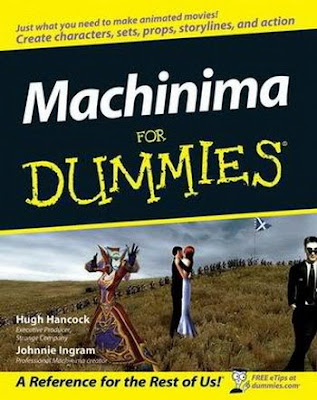
Welcome to a short course of how to make machinima. I would like to start by recommending


Machinima for Dummies comes with a CD-ROM containing the Moviestorm program for making machinima. The thing about buying a program to make machinima, such as Moviestorm or The Movies, is that you are confined to the program for the look, feel and audio of any movies you make. For this reason you should consider that the making of machinima is a process and each stage in the process is very important for what I describe as the texture of the film. I want to now go through the stages of producing a machinima film and explain what I think is important to know and what one should consider during the production process.

The film which Jenna showed, The French Democracy (2006) was made using Lionhead Studios The Movies. As a result you have backgrounds of jungle and log cabins as settings. It is important to remember that metaphor plays an important role in machinima.

Order of Production
Most machinima films that rely on narrative start with a spoken script. This is then recorded and the action is added later. It is also possible to add audio live using in-world voice software. Sound effects and incidental audio can be added later in post-production. The filming of machinima scenes can be very time consuming. Framing shots, getting avatars to do what you want, cutting out thought bubbles, and getting movements right can take many shots. You just have to go through it. Plan shots before hand taking into consideration the space, its features, if it is a high traffic area (you will have other avatars in shot) and so on.

Post-production is very similar to standard film production. You can do some editing in Camtasia but if you wish to make a more professional film, something like Final Cut or Premier.

Tools
Game Engine
The game engine is the virtual space in which you choose to set you film. There are thousands to choose from. Choose your engine based on criteria such as

- dimensions (cosmic, a city, a house, a planet)
- environment (urban, rural, gentrified, war etc)
- avatars (ethnicity, custom possibilities, costumes etc)
- actions (sex, violence, dancing, speaking, facial expressions etc)
- time period (contemporary, historical, futuristic)
- natural effects (rain, storm, ocean etc)

Image Capture
Virtual Camera

Camera Avatars
In most games the camera view is either attached to an avatar or moves in a third person (God-eye) perspective. One must think about the possibilities offered by the visual perspectives in the game engine.

Point of View
There are three main POVs in most game engines:

- First person (gamer view)
- Second Person (between users)
- Third Person (god-eye view, from above taking in characters, locations and worlds)

Second and Third person perspectives offer an independent camera view that is not attached to a single avatar. In the use of first person perspectives it is often worth using multiple camera avatars, who do not appear in the film but are used as virtual cameras in-world.


How to create a virtual camera in the Halo game engine.

Any sort of virtual camera could do
- Camtasia
- FRAPPS
- Jing
- The Movies
- Moviestorm
- WeGame
- PlayClaw

To use game platforms such as the Xbox 360 or Playstation you need to set up a video capture through another screen:


When you capture the video, there should be an options menu where you can adjust various aspects of the capture, such as quality, aspect ratio, etc

Audio
There are several ways of adding audio to your machinima film. You can use a free audio program such as Audacity. More advanced audio software such as Cubase and Protools are great but perhaps are too complicated and result in overkill for beginners. For these three programs the principle is the same; you lay audio tracks in layers, and can splice and edit them, adding effects in a visual time-line set up.

Characters
Avatars make up the graphic characters in a machinima film. Avatars are visual embodiments of users in virtual worlds. You can craft and customize avatars using skins and modeling. As well accessories can be added to avatars, such as hair, eyes, weapons, clothes.


Working on an avatar in pre-production can make all the difference in a machinima film. Skins can be purchased or made, using Photoshop.


Create and avatar skin based on the Na'vi characters from the film Avatar.

Technical Information

Three main kinds of software are needed to record machinima :

(i) sound recording software (used only for if for some reason sound needs to be recorded independently; most of the time sound recording is already included in video capture tools);

(ii) third-party video capture tools; and

(iii) video editing software. Software examples are listed below.

Flash drives or accessible storage for video files should be considered before embarking on machinima instruction on public computers or in computer labs.

Once recorded, videos can be uploaded to free public video hosting sites with online editing features for video and the original files can be deleted. Organize your files and recording using social networking sites with added features such as online editing or music mash-ups for video. Some of the new video sites have editing features for video and in some cases audio and “mash-ups” with images and video: eSocial, JumpCut, Grouper, Eyespot, Motionbox, Dabble, VideoEgg (“Online Video Editing”).

Sound Recording Tools

Audacityis a free software, cross-platform digital audio editor and recording application. It is available for Windows, Mac OS X, Linux and BSD. The latest release of Audacity is 1.3.12, a beta, released on 1 April 2010. As of 29 October 2010, it was the 10thmost popular download from SourceForge.net, with 72 million downloads. Audacity won the SourceForge.net 2007 Community Choice Award for Best Project for Multimedia.

Video Capture Tools

If you are using video games to make machinima, some games have in-game video capture options. For example, 'The Sims 2' has a movie mode, and you just point the camera and click to record. Lionhead Studios 'The Movies' also creates movies as part of the game play, or as a sandpit option (filming separately from the game content). This is the easiest way to start with machinima - acquire one of these games and get going.

Alternatively, there are programs that enable you to capture any in-game or in-world footage. Just start recording inside your game or virtual world when you're ready.


Camtasia Studio and Camtasia for Mac are screen video capture software, published by TechSmith. The program allows files to be stored in its own proprietary format, which is only readable by Camtasia itself; this format allows for fairly small file sizes, even for longer presentations. Camtasia also allows the generated video stream to be exported to common video formats which can be read by most computers, even if the Camtasia software is not installed, such as MPEG-2 or MPEG-4. PC World described Camtasia Studio as "the premier screencasting tool", which, though "powerful," can be "a little overwhelming at the start".


AviScreen Classic, which you can download for free from bobyte.com. It's totally free but doesn't record sound. The really good thing about this program is that you can customise what part of the screen you want to capture. This means you can miss off the HUD etc, so you don't have to bother cropping it later.


Fraps, which you can download for free from fraps.com. It's free for the unregistered version, which lets you record up to 30 seconds at a time and puts a small url watermark along the top of the video. Fraps can also record the audio of the game, making life that bit easier. FRAPS for PCs is optimized for games and can capture video at up to 100 frames per second depending on limits in the game. It is the best PC option for creating Second Life machinima.


GameCam- the lite version is free and you can download it from planetgamecam.com. Game Cam Lite is still Game Cam, only simpler and without the extended features set. Game Cam Lite allows the recording of real-time in game movies with sound via hot keys or an easy to use in game interface and was designed to work with most DirectX 7, 8, 9 and OpenGL games. Game Cam Lite was created for individuals who simply want to record movies.


Leadtek Winfast PVR (TV card for PC). Record your PS2, X-box etc footage with this. Stereo sound as well. Includes a hardware MPEG 2 encoder for top quality video. Definitely the easiest way to capture video from games machines.


Leadtek Winfast PVR (TV card for PC). Pretty much the same as above. Cheaper, but will do everything you need.

For Macs


Snapz Pro X allows you to effortlessly record anything on your screen, saving it as a QuickTime® movie or screenshot that can be e-mailed, put up on the web, or passed around however you want. Snapz Pro X 2.x costs $69. Upgrades from Snapz Pro X 1.x w/ movie capture are $20.

Video Editors

You'll need a video editor to turn your clips into a film. Examples of video editors are:


Windows Movie Maker- Windows Movie Maker is free with Windows XP and XP Pro but only works on those platforms. There is an older version that shipped with earlier versions of Windows, but it's very limited. Windows Movie Maker is actually a really good program, very intuitive and with lots of options for effects. It's also easy to edit clips and add dialogue and music or sound effects. Adding titles at the beginning and end, as well as subtitles, is also very easy. A great option for getting started.


Adobe Premiere Pro 2 Windows- This is great for doing blue/green screen stuff for special effects and to mix videos together, including game and real life. Make every frame count with Adobe Premiere Pro 2.0 software, the essential tool for professional video editing. Capture and edit virtually any format, from DV to uncompressed HD, and output to tape, DVD, and the web. Unparalleled integration with other Adobe applications removes production bottlenecks, freeing time so you can focus on the highest production values to tell your story. Adobe Premiere Pro 2.0 sets new standards for efficient digital filmmaking.


Premiere Elements 2- Presenting Adobe Premiere Elements 2.0 with everything you need to create videos that thrill your friends and family. The perfect combination of superior control, ease of use, and reliability, Premiere Elements automates tedious tasks so you can be creative more quickly. Import video clips from all of your digital video devices, then experiment with hundreds of professional transitions and effects to grab your audience. Burn your videos to DVD, complete with custom menus for that personal touch, or transfer them to your portable video players to wow your audience anytime, anywhere.


Pinnacle Studio Plus 10- Introducing, from Pinnacle, the worldwide leader in home video editing, Pinnacle Studio Plus version 10, the most advanced and powerful home video editing solution available today. Studio Plus combines the legendary ease of use of Studio's intuitive three-step movie creation process with the power and quality of the Pinnacle Liquid Engine to quickly and reliably capture all of your media from popular consumer electronic devices including the newest top quality HDV cameras and even video phones. Studio Plus provides users with the ultimate control with the addition of 100's of breathtaking user-defined keyframeable real-time effects, like HD Pan & Zoom, picture and picture and Chroma Key. Effortlessly, add music and titles and you are quickly creating blockbuster home movies for sharing on DVD, the Web and beyond.


Ulead Video Studio

  • Over 1000 Customizable Effects, Filters, Transitions and Title Styles - Simply drag and drop to personalize your movie

  • 16:9 Widescreen Support creates wide screen movies for a true home theatre experience

  • Chroma Key Editing - lets you place your subjects into different backgrounds

  • Pan and Zoom lets you scan over still images to create a motion effect

  • Share and preserve your home videos on DVD, CD, tape, the Web, or mobile


Adobe Encore 2 Windows- DVD authoring - Adobe Encore DVD software takes DVD authoring to a new level of creativity and efficiency. Through its flexible interface and unparalleled integration with Adobe Premiere Pro, Adobe Photoshop CS, and Adobe After Effects, Adobe Encore DVD gives professional videographers, DVD authors, and independent producers the power to create sophisticated multi-language DVDs with interactive menus and multiple audio and subtitle tracks. With Adobe Encore DVD, you can produce consistent, high-quality results, and output to all recordable DVD formats for a wide degree of playback compatibility.


Adobe After Effects 7 ProWindows- Expert effects - Wow your audience with visual and audio effects considered indispensable at leading studios, including grain effects, Glow, Advanced Lightning, and Optics Compensation. Flexible distortion effects Distort and morph footage using Mirror, Ripple, and other effects, and paint distortions directly onto imagery with Liquify. Timewarp - Slow down and speed up footage with smooth, crisp results and minimal artifacts. Timewarp analyzes pixel motion to create more accurate in-between frames.

Links


Books and References

Berkeley, Leo. “Situating Machinima in the New Mediascape.” Australian Journal of Emerging Technologies and Society. 4:2 (2004), 65-80.

Hancock, Hugh, Ingram, Johnnie. Machinima For Dummies. Aug. 2007.

Kelland, Matt, Dave Morris, and Dave Lloyd. Machinima. Boston, MA: Thomson/Course Technology. 2005.

Landay, Lori. “Virtual KinoEye: Kinetic Camera, Machinima, and Virtual Subjectivity in Second Life.” Journal of e-Media Studies. 2:1 (2009), 1-33.

Long, Geoffrey, “Interview with Paul Marino”, Transformative Works and Cultures, Vol. 2, 2009, 1-7.

Lowood, Henry. “High-Performance Play: the making of machinima”. Journal of Media Practice. 7:1 (2006), 25-42.

Lowood, Henry. “Real-time Performance: machinima and game studies”. The International Digital Media & Arts Association Journal. 3:1 (2005).

Lowood, Henry. “Found Technology: players as innovators in the making of machinima” in Tara McPherson (ed.), Digital Youth, Innovation and the Unexpected, Cambridge, Mass.: MIT Press, 2008.

Marino, Paul. 3D game-based filmmaking: the art of machinima. Scottsdale, Ariz: Paraglyph Press. 2004.

Nitsche, Michael, “Claiming Its Space: Machinima”, dichtung-digital, at www.dichtung-diigtal.org/2007/nitsche.htm, 2007.

Thursday, December 9, 2010

Virtual worlds - can it really be anything for businesses? If developments and trends (2 hr lecture / workshop FSV 1, 2, 7)


Virtual worlds are three-dimensional digital spaces that are distributed over the Internet, where large numbers of people can communicate, interact, create and consume both virtual and physical goods and services. Branding is a major presence in virtual worlds like Second Life, Entropia Universe, Planet Calypso, and Blue Mars. This lecture and workshop will focus on how some companies have used virtual worlds, including the mistakes they have made and how the media can be improved in terms of development of a customer base, profiling the business and creating a brand presence in virtual worlds. Case studies discussed include the Second House of Sweden and the business model employed by Planet Calypso.

Background Factors to Virtual Worlds and Business


Age is a particularly important factor in the virtual worlds. Most of the users of virtual worlds are today under 15 years of age.

It is estimated that there are over one billion registered accounts in virtual worlds today. An estimated 700 Million of them are under the age of 15.

What are Virtual Worlds?
The concept of a virtual worlds can be distinguished from the concept of game space by the absence of the characteristics of a “game.” Bell (2008) presents a number of previously proposed definitions of a virtual world and proposes a synthesized, more contemporary definition that attempts to take into account changes that have appeared in virtual worlds over the past several years (Chesebro, 1985; Bartle, 2003; Koster, 2004; Castronova, 2004). Bell states that a virtual world can be defined as “a synchronous, persistent network of people, represented as avatars, facilitated by networked computers” (2008, p. 1). Bell’s definition has three key components:

1. “synchronous” indicates that shared activities necessitate synchronous or real-time
communication

2. “persistent,” as explained previously, indicates that a “virtual world cannot be
paused” or does not shutdown when the user exits

3. the “avatar” is “any digital representation (graphical or textual), beyond a simple
label or name, that has agency (an ability to perform actions) and is controlled by a
human agent in real time” (2008, p. 1).

Schroeder emphasizes the experiential element of virtual worlds. Schroeder defines a
virtual environment or, equivalently, a virtual reality as “a computer-generated display that allows or compels the user (or users) to have a sense of being present in an environment other than the one they are actually in, and to interact with that environment” (Schroeder, 1996, p. 25). “Virtual Worlds Research: Consumer Behavior in Virtual Worlds”
There are three main forms of business in relation to virtual worlds:

1. Virtual goods and services
Virtual goods are non-physical objects that are purchased with real money for use in online
communities, virtual worlds, or games and fulfill a functional or decorative purpose in an online
environment. Virtual goods are typically priced from $1 to $3, but can be sold for much higher prices depending on scarcity, functionality, and design. Virtual goods include weapons or tools that help players progress in a game, decorative items like avatar gear or profile themes that allow users to express their individuality, and virtual gifts that enhance communication between friends and family. Perhaps most importantly, virtual goods also act as social badges that, depending on the social context, can convey a level of status, achievement or acceptance similar to that associated with ownership of real status symbols.

The Entropia Universe entered the Guinness World Records Book in both 2004 and 2008 for the most expensive virtual world objects ever sold, and in 2009, a virtual space station, a popular destination, sold for $330,000. This was then eclipsed in November 2010 when a player sold a virtual resort on Planet Calypso for $635,000; this property was sold in chunks, with the largest sold for $335,000.

2. Branding
The American Marketing Association (AMA) defines a brand as a "name, term, sign, symbol or design, or a combination of them intended to identify the goods and services of one seller or group of sellers and to differentiate them from those of other sellers.

Therefore it makes sense to understand that branding is not about getting your target market to choose you over the competition, but it is about getting your prospects to see you as the only one that provides a solution to their problem.

The objectives that a good brand will achieve include:

* Delivers the message clearly
* Confirms your credibility
* Connects your target prospects emotionally
* Motivates the buyer
* Concretes User Loyalty

Branded Virtual Goods (BVGs) are virtual goods that – in addition to offering some functional or
decorative value – display an insignia, copyright protected mark, logo or derivative image of a known brand, and by virtue of being “branded”, command a higher social and monetary value among end users. This premium positioning is analogous to the difference between generic and branded products in the real world where branded items typically sell more units and fetch higher prices than their generic counterparts. A plain white t-shirt can be transformed from a cheap commodity to a sought-after product by incorporating the mark of a well-known company or celebrity. Brands have a similar impact on virtual goods. In this report, we define brands broadly, i.e. they include not only popular consumer brands, but also images of and associations with celebrities, famous athletes, sports teams, colleges, movies, musicians and televisions shows. In short, a brand creates a point of differentiation in the user’s mind, and this differentiation represents an opportunity for monetization that is not found in generic goods.
See Branded Virtual Goods Market Report : Opportunities and Strategies for Aligning Brands with Virtual Goods (August 2010)

Nation branding is a field of theory and practice which aims to measure, build and manage the reputation of countries (closely related to place branding). Some approaches applied, such as an increasing importance on the symbolic value of products, have led countries to emphasize their distinctive characteristics. The branding and image of a nation-state and the successful transference of this image to its exports - is just as important as what they actually produce and sell. The Second House of Sweden is a virtual world example of nation branding.

3. Provision of a virtual world and related media
Creating a virtual world from scratch and building a community to populate it is a long terms and specialized occupation. There are free development tools around, NeL gives you a skeleton, for free, but wants half a million Euros for a something you could actually use. Kaneva's game engine is more complete, but you can't use it for free-to-play worlds of any scale (ie. more than 30 players - and they want to host it on their own network). RealmForge is very good except for its network features, although it is rapidly improving in that area. RealmCrafter is only $55, so it's practically free, but its graphics engine is dated and it's still something of a work-in-progress. BYOND is 100% free, and is excellent - if you don't mind having a 2D world rather than a 3D one. Multiverse is a complete, end-to-end platform solution that is free for non-commercial use. The business model appears to be to build up an installed base of Multiverse browsers through free games, thereby making the platform attractive to commercial developers (who will have to pay to use it).


Links for Further Reading
Robin Teigland
Robin Teigland is an Associate Professor at the Center for Strategy and Competitiveness at the Stockholm School of Economics (SSE) as well as the caretaker of SSE’s island in Second Life. She is also the Program Coordinator for SSE's PhD program in Business Administration and a member of the faculty of the International Management PhD program at the University of Agder in Norway.

The work of the Berkman Professor of Entrepreneurship Legal Studies at Harvard University, Yochai Benkler is influential in my approach to the role that virtual worlds can play in business. His book, The Wealth of Networks: How Social Production Transforms Markets and Freedom (2006) should be considered as background to my lecture.

Revenue recognition on the sale of virtual goods


Hypergrid Business: THE MAGAZINE FOR ENTERPRISE USERS OF VIRTUAL WORLDS
By reading Hypergrid Business. We offer in-depth and up-to-date coverage of the OpenSim technology and community, which is currently the leading contender to be the hyperlinked 3D Web, with news, case studies, opinion, and feature stories. We also cover alternative open source platforms like Open Wonderland, and proprietary enterprise platforms like ProtoSphere and Teleplace.


Selected Bibliography

Alexander, T. (2003). Massively multiplayer game development. Hingham, MA: Charles River
Media.

Alexander, T. (2005). Massively multiplayer game development 2. Hingham, MA: Charles River
Media.

Bartle, R. (2004). Designing virtual worlds. Indianapolis, IN: New Riders Publishing.

Bell, M. (2008). Toward a definition of “virtual worlds”. Journal of Virtual Worlds Research.
1(1). Retrieved on November 1, 2008, http://www.jvwresearch.org/v1n1_bell.html

Bittarello, M. B. (2008). Another time, another space: Virtual worlds, myths and imagination.
Journal of Virtual Worlds Research, 1(1). Retrieved on November1, 2008, from
http://journals.tdl.org/jvwr/article/view/282/236

Burdea, G. C., & Coiffet P. (2003.) Virtual reality technology. Hoboken, NJ: John Wiley &
Sons.

Castronova, E. (2004). Synthetic worlds. Chicago: The University of Chicago Press.

Damer, B. (2008). A brief history of virtual worlds as a medium for user-created events. Journal
of Virtual Worlds Research, 1(1). Retrieved on November 1, 2008, from
http://journals.tdl.org/jvwr/article/view/285/239

Hays, G. (2008, August 5). The social virtual world’s a stage. Retrieved on November 1, 2008,
from http://www.personalizemedia.com/2008-metaverse-tour-video-the-social-virtual-
worlds-a-stage/

Hypography. (2007). What is an acceptable definition of “game”? Retrieved on November 1,
2008, from http://hypography.com/forums/linguistics/9953-what-acceptable-definition-
game.html

Koster, R. (2004, January 07) A virtual world by any other name? [Msg 21] Message posted to
http://terranova.blogs.com/terra_nova/2004/06/a_virtual_world.html

KZero. (2008a). Universe. Retrieved on November 1, 2008, from
http://www.kzero.co.uk/blog/?page_id=2537

Oldenburg, R. (1989). The great good place: Cafes, coffee shops, community centers, beauty
parlors, general stores, bars, hangouts, and how they get you through the day. NY: Paragon
House.

Oldenburg, R. (1991). The great good place. NY: Marlowe & Company.

Oldenburg, R. (2000). Celebrating the third place: Inspiring stories about the "Great Good
Places" at the heart of our communities. NY: Marlowe & Company.

Schroeder, R. (1996). Possible worlds: The social dynamic of virtual reality technologies.
Boulder, CO: Westview Press.

Schroeder, R. (2006). Being there and the future of connected presence. Presence: Journal of
Teleoperators and Virtual Environments, 15(4), 438-454.

Schroeder, R. (2008). Defining virtual worlds and virtual environments. Journal of Virtual
Worlds Research, 1(1). Retrieved on November 1, 2008, from
http://journals.tdl.org/jvwr/article/view/294/248

Schwienhorst, K. (1998). The ‘third place’ – virtual reality applications for second language
learning. ReCALL, 10(1), 118-128.

Sivan, Y. (2008). 3D3C real virtual worlds defined: The immense potential of merging 3D,
community, creation, and commerce. Journal of Virtual Worlds Research, 1(1). Retrieved
on November 1, 2008, from http://journals.tdl.org/jvwr/article/view/278/234

Smart, J.M., Cascio, J., & Paffendorf, J. (2007). Metaverse roadmap overview. Retrieved
December 3, 2008, from http://www.metaverseroadmap.org/overview/

Soukup, C. (2006). Computer-mediated communication as a virtual third place: Building

Oldenburg’s great good places on the world wide web. New Media & Society, 8(3), 421-
440.

Steinkuehler, C. (2005). The new third place: Massively multiplayer online gaming in American
youth culture. Tidskrift för lärarutbildning och forskning, 3, 16–33.

Steinkuehler, C., & Williams, D. (2006). Where everybody knows your (screen) name: Online
games as “Third Places.” Journal of Computer-Mediated Communication, 11(4), article 1.
Retrieved December 3, 2008, from http://jcmc.indiana.edu/vol11/issue4/steinkuehler.html

Stephenson, N. (1992). Snow crash. New York: Bantam Books.

Taylor, T. L. (2006). Play between worlds: Exploring online game culture. Cambridge, MA:
MIT Press.

Wadley, G., Gibbs, M., Hew, K., & Graham, C. (2003). Computer supported cooperative play,
“Third Places,” and online videogames. In S. Viller & P. Wyeth (Eds.), Proceedings of the
Thirteenth Australian Conference on Computer Human Interaction (OzChi 03) (pp. 238-
241). Brisbane, Australia: University of Queensland.